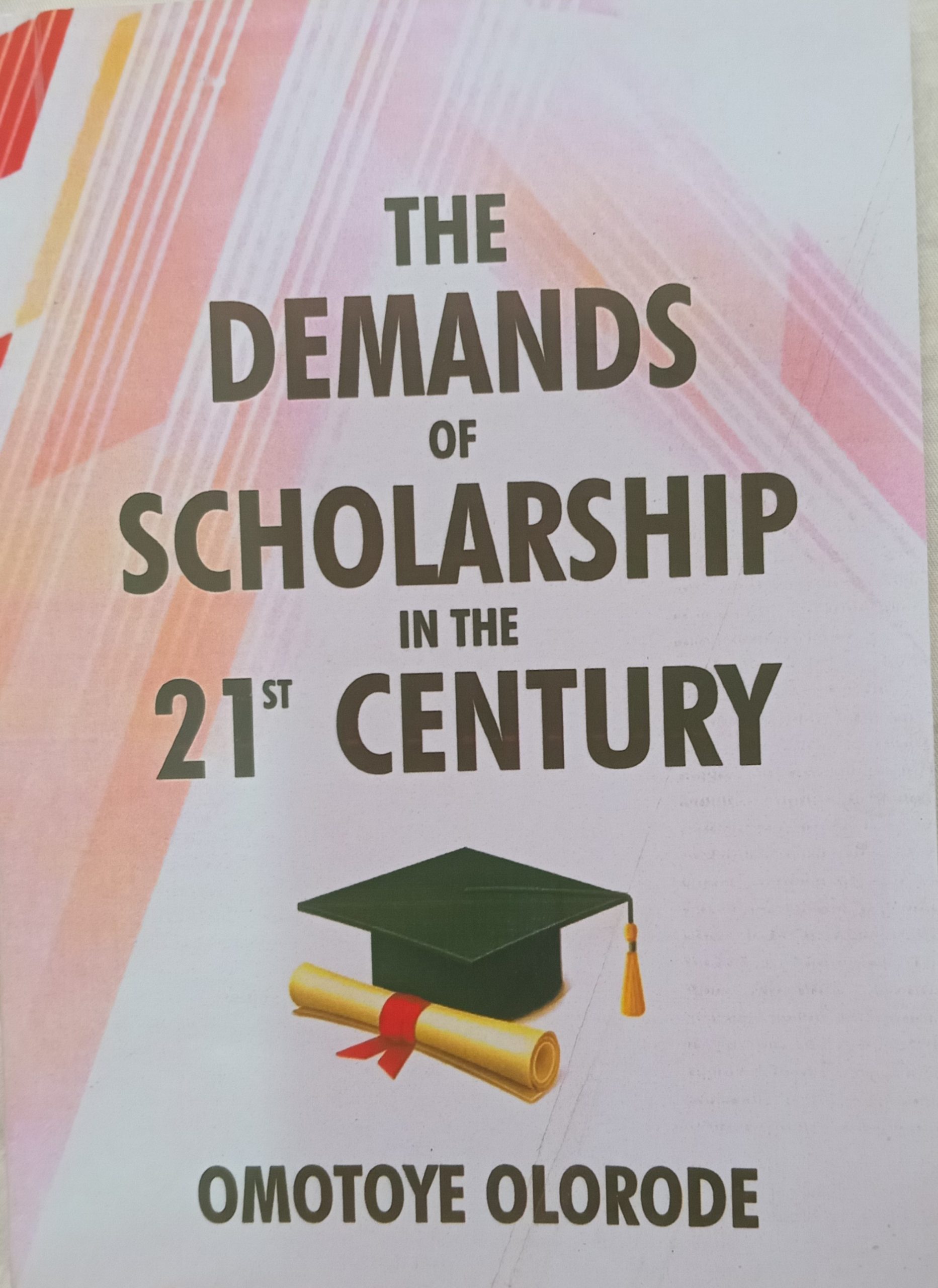
Text: The Demands of Scholarship in the 21st Century
Author: Prof Omotoye Olorode
Pages: 78
Year: 2023
Publisher: CITAD, Kano
Reviewer: Adagbo Onoja
Like the banana tree which gets cut down whenever it bears fruit, Intervention brought being asked to review Prof Toye Olorode’s The Demands of Scholarship in the 21st Century on itself by using the cover page to illustrate Olorode’s recent tribute to the late Prof Biodun Jeyifo. Yes, a snappy review is doable in spite of Intervention’s severe time constraint.
Prof Olorode’s The Demands of Scholarship in the 21st Century is a 78 page text and a 2023 publication. The language is activist from the first to the last page. In fact, nothing would have been lost if it were titled Manifesto for Activist Scholars. The take-off point is the notion of scholarship as knowledge for truth and service and which, for the author, is what the Academic Staff Union of Universities (ASUU) is all about. But even then, he insists on knowledge as derivative of systematicity and rigour, a surprising obeisance to positivism.
His is a contextual foray, a context he quickly specifies in the imperative of organic scholarship when scholars operate in an unequal social milieu in which 0. 01 percent have excluded the vast majority, leaving them high and dry. Scholars in such milieu must assume an organic self-understanding as the reality of a fortified hegemonic Other has become an obstacle to liberation.

Prof Olorode
In other words, the problem is not that there is deficit in the supply of knowledge in the world today. No. Olorode tells us that John Maynard Keynes’s prediction of adequate knowledge by today has more than come true. So, there is so much inequality and poverty not due to shortage of knowledge to make the equal and poverty-free society possible but because capitalist exploitation has cornered knowledge, notwithstanding actually existing socialist and national liberation alternatives. Said Olorode:
“… although overall and massive material wealth , enough to create basic and generalised good life for most human beings became available, massive poverty, squalor, inequality, epidemics, largely man-made and capitalist, environmental disasters, deforestation including desertification, floods, crop failures, over-exploitation of natural resources, violence and wars (inter-community, intra-national and international) have forced massive population movements, refugee crisis and human migrations created originally and subsequently maintained by former European migrant conquistadors”(p. 14).
He then launches a blistering attack on post-industrialism and postmodernism, the sources of what he calls “the active hubris of technical solution and technocracy” (page 15), dismissing their inevitability or salutary outcomes. Instead, he consigns them to the Western vision before the text moves to another round of attack, this time on the global ‘reset’ agenda’ popularised by the gentlemen behind the Davos annual gathering. The Davos experiment is situated as part of efforts by intellectual and ideological centres of imperialism and capitalism to make it work through what Robert Cox, one-time DG of the International Labour Organisation (ILO) called problem-solving theory in a famous 1981 essay. Simplified, a problem-solving theory mentality is what mechanics do: repairing a car even when ignorant of the grand automobile framework underpinning the car. That is to say, by extrapolation, that the bankers, mortgage moguls and ideologues who gather in Davos are mechanics trying to repair capitalism without caring about understanding its logic. Olorode is even more scathing when he shifts his gaze to Nigeria, drawing attention to the phenomenon whereby all presidential candidates in the 2023 election subscribed to the global ‘reset’ imagination. But he finds a fulfillment of Fanon’s contention in the early 1960s that poverty is not the result of backward technology but of exploitation and that the corroboration for this is to be found in no drop in the rate of poverty in the United States – the most technologically advanced country. (21). Connected to Nigeria, Olorode returns a predictable verdict: “In the peripheries of neoliberal capitalism like Nigeria, the rampaging agency of bourgeois scholarship… has produced a particularly grotesque conjuncture including in the education sector and the culture industry overall” (p. 22).
Olorode moves to the knowledge industry, framing intellectual property rights practice as a regime of legalized seizure by capitalist expropriation and privatisation, deepening inequality, seizure of artefacts from colonised countries for display in metropolitan museums down to acts of robbery in global biodiversity. In extending this analysis to the culture industry, the author narrows on the politics of hegemony or ‘the story of who is told’ down to:
“the role of the neocolonial state, its bureaucracies including the National Universities Commission (NUC) and their consultants (like the one supervising CCMAS) and the Accountant – General (of the Federation) that sought to impose IIPIS; the Ministry of Labour that imposes no-work-no pay towards liquidating trade unions is to implement the ideology of capital by imposing curricular and privatisation of the entire sector” (p. 31).
The language of analysis here requires quoting the author further, viz:
The attacks on, and blackmail of, the Nigerian university system, on scholarship and on scholars epitomised by IGR-ism, IIPIS, insistence of Government Negotiating Teams at the ASUU-FGN negotiations on what they call KPI (Key Performance Indices): managerialism – university ‘management’ versus university ‘workers’- as distinct from collegial university system; imposition of courses and syllabus on university senates by NUC contractors, the World Bank and multinational ‘educational’ consultancies … are not just flukes at the periphery of neoliberal capitalism like Nigeria” (p. 32).
There is no forgetting to add that fighting a World Bank supervised university framework is what ASUU has been onto along with the students’ movement and what Olorode calls the more conscious segment of the organised labour since the 1970s. Unfortunately, dependence on Western intellectual traditions has produced a situation in which some Western educated elite have, in the opinion of the author, “succumbed to the perspective that societies outside the West have nothing to say about anything or about themselves” (P. 34). Olorode singles out two quarters: Prof Tanimu Abubakar of the Ahmadu Bello University, Zaria and Prof Toyin Falola (of the University of Texas at Austin but who was speaking at the University of Lagos) insisting on decolonisation of education in Nigeria, something he said had been anticipated by what one may call the strike group peopled by members of the earlier generation of African scholars and activists. On Olorode’s list of them are Cheik Anta Diop, Waziri Junaidu, Nnamdi Azikiwe, Frantz Fanon, Malcolm X, Mokwugu Okoye, Kwasu Wiredu, Ola Oni, Eddy Madunagu, Bade Onimode, Omafume Onoge, Eskor Toyo, Fela Anikulapo-Kuti, Festus Iyayi, Segun Osoba, Bala Usman, to mention just a handful.
Then the analysis turns to dialectical reading of recovery, an endorsement basically of classical Marxist formulations from page 38 to 40 before veering to the theme of “Rebellion, Ambivalence and Co-optation of Africans into the Hegemonic Project of Western Philosophy and Worldview”. Here, we have two names picked to exemplify keeping faith with ontological self-awareness. One is Akinsola Akiwowo of Obafemi Awolowo University, Ile-Ife while the other is the elder’s elder and Economist, Ojetunji Aboyade. Those Olorode calls ‘professional philosophers’ are not that lucky with Prof arising from their tendency to ambivalence. Prof complains of Cornell University’s Prof Femi Taiwo confusing him in his (Taiwo)’s book titled Africa Must Be Modern. (P. 44). Olorode descends on the idea of ‘African philosophy as folk thought’. In fact, he is annoyed by that and he devotes the next four or so themes in the lecture which transformed into the booklet to the crisis of the sociology of knowledge in Africa vis-à-vis mobilising scholarship for national liberation and liberation of the oppressed. The text draws to a close with some home-truths about the changing phases of the ASUU struggle.
It doesn’t take much time to complete reading the text, more so for anyone who has known Prof Olorode. He is not just a hard headed subscriber to the materialist interpretation of history, he has remained within its remit in terms of practices, models and gestures. This is the soul one encounters in The demands of scholarship in the 21st century. It makes a snappy review near impossible because Prof Olorode’s capacity to unleash the seductive power of the Marxist visualisation of the social is intact even at mid-eighty or so in terms of age. Still, the reading act implies a (re-) writing act and we can, therefore, not escape the question of where Olorode’s text leads us to or has left us.
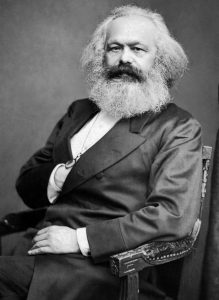
Still at the center of radical scholarship and practices but not beyond interrogation and the subsequent reformulation of canons
There are hardly any descriptive details to challenge in the entire text. His reservations are not just a case of ideological critique, most of them have been experientially derived. Experience-based details do not prove anything but they provide the relationalist with what to start with. Defining the mission of ASUU as struggle for social transformation is what defines the entire text. It is not a misplaced thinking. It invokes the knowledge/power paradigm. In other words, the meaning-making nature of scholarship implicates every scholar in the production of reality. This takes on an aggravated dimension where unequal power relations is so staggering as in Nigeria. ASUU members cannot escape involvement in hegemonic contestation in such a situation. ASUU as an organisation is thus a fitting response to the logic of the slogan, ‘Don’t agonise, organise’ which the late Tajudeen Abdulraheem popularised.
The little problem is the author’s extreme confidence in the kind of theoretical framework he favours vis-vis routing the imperialist construction of the scholarly edifice in Nigeria. In political theory, for instance, there are few consensus areas. One of it is that ontology is not the sweater we wear and pull as and when we want. Olorode struck the cord in decrying the displacement of the African ontological and epistemological grounding from our educational practices, making us to be about the only such case in the world. But the Marxist theory and ideology he approves rests on positivism, a colonising metatheory. That we are groomed in positivism through and through manifest in our unending emphasis on the search for proof, for evidence, for the truth and so on even when truth always has ownership. The implication is that we entangle ourselves into idolatry even in our Marxism, most times doing what Marx never asked us to do. And this is to a depth that even recent interesting developments in Europe and China, just to cite two examples, do not interest us.
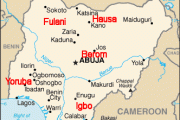
Not being interested in post-Cold War metatheoretical developments in Europe, for example, our Marxism is unable to factor in new analytical realms such as affect and the way emotion, memory, heritage and all such categories defining new conceptions of self and translating to new forms of contestation in the intra-clan, intra-tribal, intra-regional and sundry intra-group flares and so on we see today. Locked in positivist binary categories of either/or traceable to Western metaphysics, Marxists in Nigeria are in danger of complicity in fomenting clan, ethnic or tribal violence as they cannot see beyond one side being right and another side wrong. So, even if ASUU were to have successfully transformed into what its masterminds planned in terms of struggle for national liberation, there would still have been problems. This is with particular reference to the bareness of the ontological anchor for the kind of knowledge that will produce the self-understanding capable of sustaining the struggle for change against a fortified hegemonic Other Olorode mentioned early in the script. Apart from those in Linguistics/Languages, (Hausa, Yoruba, Igbo, etc) and Literature/Drama and perhaps Archeology, the ontological and epistemological crisis of our educational system is of a tragic proportion and the blame lies more with academics and scholars than with NUC and the FG or even the World Bank.
To take an example, International Relations as a discipline is almost undergoing a nomenclature adjustment into Global International Relations. Where is that coming from? It cannot be accounted for without referencing Stanley Hoffman’s 1997 essay, “An American Social Science: International Relations”, irrepressible voices such as Bristol University’s Gurminder Bhambra or LSE’s Tarak Barkawi who specifically maintained that social science has problematised empire out of knowledge and the works of the early ‘dissidents’ in IRs in the late 1980s. subsequently, the ‘worlding Beyond the West’ series in International Relations capturing this shift has transformed into a phenomenon. This is a significant part of the struggle for hegemony or against hegemonic scripts since the concepts, theories and methods they advance partake in mostly disrupting hegemonic scripts. None of this seems to be reflected in our International Relations, Political Science in Nigeria. Instead, Department of Political Science and History in many of the universities are engaged in the laughable fighting over where International Relations belongs. The world has gone beyond that.
The politics of ontology is that it is very easy to overcome. The overarching paradigm which will drive it will be an area of a huge debate but the process can start with recovering the Ibadan School of History. There is no alternative to it because the argument that made orality a credible source of knowledge can be generalised. The achievement of the Ibadan School of History is, arguably, reducible to that. This is urgent because knowledge structure changes every time there is a geopolitical shift as is currently unfolding with the unfolding of China as a great power. If not now, then there may be no Olorodes or those who have seen the changing phases of this crisis to remind us about it when we might wake up to its consequences.
From hindsight, we should not shy away from throwing potshots at our dear Olorodes: there are no reasons why they didn’t become Vice-Chancellors and reshape the universities up to a point. They were, morally, ethically, ideologically and academically, as qualified if not more qualified than anyone else in the system then. Although VCs in those days followed the logic of the university idea, things might not have degenerated to where they are now if the Olorodes took over in Ife, Zaria, UNILAG, UNIJOS, UNN, UNICAL and many more. Prof Olorode is forgivable, having written this booklet, especially if he could use the next few weeks to expand it into a fuller text and get it republished.