By Adagbo Onoja
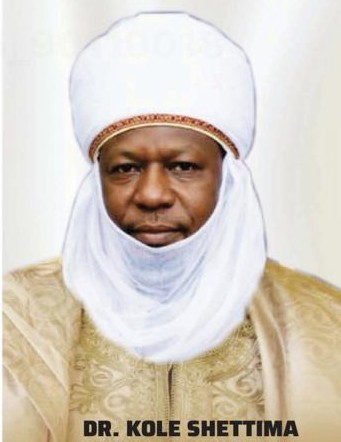
In any other clime, the induction of a leading civil society actor into traditional authority would be a high-profile event and a big media story. It is no surprise that the turbanning of Dr Kole Shettima of the MacArthur Foundation as ‘Zanna Yuroma’ – a resource person to the Emir of Machina in Yobe State of Nigeria – is in the news. It has to be in the news because a civil society activist with a PhD in Political Science and an academic touch to it would, going by the literature, be the antithesis of the traditional authority. While the civil society person comes into personhood through “the war of position” strategy, the traditional authority is largely about preserving what has been so that the world is as it has been and ever shall, world without end or something like that. So, there is a sense in which the turbanning of Dr Kole and his two other colleagues as traditional title holders in Machina Emirate is a headline stuff.
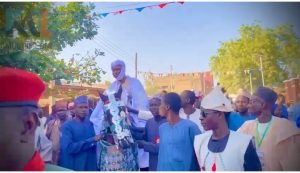
Man on horseback, in the traditional sense!
But that sense of the modernising elite as an antithesis of the traditional authority is where the puzzle comes up from: how does anybody draw the boundary between the modern and the traditional? Is there such a boundary? Or is this another fiction fabricated and circulated by positivism? And how do we find the kind of interpretation (not evidence) that will tell us whether modernity as antithesis of tradition is positivist fiction or not? Positivism can be crudely defined as a way of knowing which privileges only that which we can experience, observe or measure and capture, mostly numerically. One level of the problem with positivism is that more than 70 % of social reality cannot be measured or observed. That is why positivism cannot explain why religion, for example, is still such a big influence on people when positivists thought that, by now, religion would have withered away.
We can try to unpack the puzzle of whether tradition and modernity can be demarcated. It is in our interest to try to do so, a task which Dr. Kole’s moment reminds us of the importance of accomplishing it. And we start from far away Ethiopia whose prime minister, Abiy Ahmed, used to be a military officer of the intelligence arm and had a stint in the US military. That background makes him a perfect example of the modernist/modernising elite, going by what Max Weber told us in his books. After Plato, Hegel and Marx, Weber is the other high priest of the Western imagination of the world until the rise of Jacques Derrida with his game changer called deconstruction. Deconstruction rules the world today even as most of its users do not know they are into it.
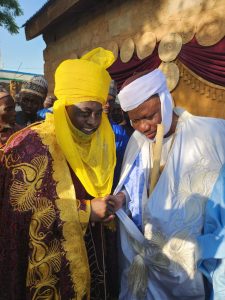
Two of a kind!
One of Weber’s fascinating arguments concerns the military. According to Weber, the armed forces is the only perfect fit institution in the ‘Third World’, for example, as far as rational – legal type of authority is concerned. There, you get promoted by passing examinations. You win or lose a war by your map reading or sharp shooting skills, not by which tribe or religion you come from and so on. Weber was the reason the West promoted military rule in Africa until they suddenly found a new poison called democracy after the Cold War.
But, in September 2022, when a Staff Writer with The New Yorker published an over 9000 word long write-up on Abiy after an up, up close visit to Addis Ababa, it turned out that Abiy reads the world largely in the image of Emperor Haile Selassie, a monarch’s monarch rather than the rational or calculated world of military strategy. In fact, Stefan Darcon, an Oxford Professor of Economics who has a history of advising previous Ethiopian governments argues that to the extent that Abiy has any vision at all, it is his regard for the late Emperor Haile Selassie as “ultimate validation of Ethiopia’s claim to national grandeur”. And that Abiy, in fact, had a Pentecostal gospel imaginary.
While no one needs necessarily accept what a professor says, especially a professor who obviously has grudges against an incumbent, the point Darcon makes is that, however one looks at it, Abiy operates not by the rational kernels of his modernist training in the military but more by the slippery logic of messianism, be it of the ‘king of king/conquering lion of Juda/elect of God’ variety by which Selassie was known or of Pentecostal faith. This is particularly as Abiy leaves no one in doubt about his messianic inclination, telling his The New Yorker interviewer: “when I leave office, I am hundred per cent sure – I am hundred per cent sure – that millions of Ethiopians will cry”.
Long before he came to power, he told his superiors he would become the prime minister of Ethiopia. One of his superiors told him it was a dangerous thing to say because they will kill him. He merely laughed. He did say long before it happened that he would win a Nobel Peace Prize. And that he would rebuild Ethiopia. He has become prime minister and has won the Nobel Peace prize in 2019 without much ado. He is fast rebuilding Ethiopia into a signifier of modernity in Africa. So, where does tradition stop and modernity start in him? There is no science that can account for these sort of predictions. Social science in particular has been a disaster in prediction because it has no tools beyond covering law and associated correlation, covariation and similar positivist techniques, none of which can predict anything.
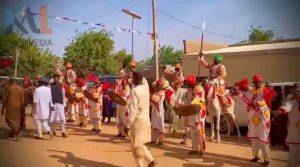
Pomp and pageantry
Chinua Achebe took the question of the modernity – tradition tension to an explosive height before his death. In 2005, he granted an interview to an American professor, Roger Bowen. In it, he said that although he could not imagine calling his parents traitors but that his generation could not see what the generation of his parents saw before ditching the traditional ontological regime signified by the conceptual master code called ancestor. Throughout their lifetime, Achebe and the foremost African-American Nobel Prize winner in Literature, Toni Morrison articulated the primacy of the ancestor. Of course, Morrison is the author of the incredible 1983 interview called Rootedness: The Ancestors As Foundation. Who can be more modern than an Achebe and a Toni Morrison?
In Jigawa State in 2007, a redemptive surge berthed at a policy of paying the most alienated members of the society a stipend. The policy was clear in terms of coverage: the beneficiaries must be physically challenged persons, those whose alienation is such that they can’t write a petition or stage even a peaceful protest to bring experiences of deprivation to the attention of the government. Up to that point, the rhetoric was fine because the stipulated stipend was higher than the two dollars a day by which the World Bank pegged the poverty band.
The problem was how to generate a credible list of physically challenged persons in the state. No section of the modern bureaucracy had the data or the methodology for accounting for physically challenged persons. But the traditional authority had the data. And it was the traditional authority which saved the day because, in the Emir’s palace, each category of the physically challenged had a leader (the king of the blind, the crippled and so on). Not only that, the Emir’s palaces have better records of births and deaths. It is possible this is peculiar to Northern Nigeria where the colonialists devolved power to that layer of authority. Nevertheless, it was an eye-opener, especially for a radical activist whose overconfident socialist inclination never thought of that possibility. In the end, the relationship between a governor’s advisor and an Emir developed more tightly. It turned out that the Emir in question was an American-educated Economist. Again, the boundaries between tradition and modernity here are too fused to be delineated.
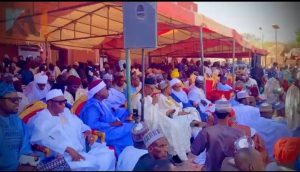
Elite and tradition in Africa
Let us be patient to take one more example but one which does not conform to the previous ones even as it illustrates the falsehood of a superior modernity/inferior tradition. It is a long time one heard this story and the details may no longer be that intact but it goes something like this. A modernist (or is it modernising?) elite in power found to his chagrin that the supposedly modern government was actually a study in chaos, protocol wise, when in full swing. Unlike in the traditional authority where every traditional title holder knew his ranking order and seating position, no such thing applies in the modern government’s council chambers, contrary to the notion of the modern government as the claimant to the heritage of modernity in post-colonial entities. Beyond perhaps the Justice Minister and probably one other, in terms of a fixed seating position in relation to the president or governor as the case may be. The rest of the ministers sit wherever a seat could be found. What he was seeing was a reversal; the modern which lacks that organisational coherence as the traditional over which it claims superiority.
The tension between the modern and the traditional on the one side and the inseparability of the two domains on the other applies throughout Africa as well as much of Asia and Latin America. The only difference between Africa’s and the other two continents might be that their academics are studying the problem without apologies. In Nigeria, for example, the picture of a famished space in this regard is commoner vis-à-vis competently making sense of the complexity of our world.
There are exceptions though. It is a commonly heard story, for example, that a particularly prominent Nigerian military officer declined to take over leadership of Nigeria each time the opportunity offered itself because his father told him never to take Nigerian leadership. There is no way of verifying this sort of stories but it is true at the factual level that the named officer had more than two opportunities to assume power, bloodlessly. What it means is that, long before Abiy in far away Ethiopia, we experienced a military man who feared his own ancestors more than he trusted his military training. In any case, former president, Olusegun Obasanjo once advocated instrumentalisation of juju to deal with Apartheid. Modernists or people who claim to be so laughed him to scorn but, as late Mallam Aminu Kano was used to querying, is it every one of us who can do what the ‘boka’ (native physician) does?
Who knows, the Zanna Yuroma might have worked out his own ways of territorialising and reterritorialising the tension. Long live Zanna Yuroma of Machina Emirate!