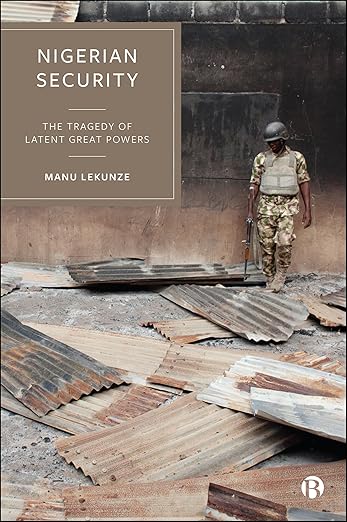
It is one thing to hear as frequently as it occurs in recent years but a different thing to read that Nigeria, one’s own country, is living on borrowed time because it may not survive the 21st century. Yet, the researcher making the pronouncement is presenting the overarching argument of a book that has passed through a credible editing process and has been published by a printing press as credible or established as they come – the University of Bristol. It is a book whose author teaches International Relations at the University of Aberdeen in the UK, well reckoned with.
From Intervention‘s lenses, the data amassed to demonstrate the claim is, comparatively, substantial, touching on governance (in)capability; the magnitude of economic vulnerability of Nigeria, the low military power projection indices and the geopolitical tension in the context of heightened great power security competition. It is a ‘scientific’ work about which there is no debate although it is using a theoretical insight – Realism – which has been battling for survival since the end of the Cold War.

The soul of Nigeria
But, published in 2025, it is a book the intellectuals of statecraft in the Nigerian armed forces, the Nigerian intelligence community, the more established think tanks and a certain layer of political office holders and politicians have to read or which most of them would have read by now. The reason this set is singled out is that they form the first line of defence to deal with the not-so-new but too categorically articulated claim of Nigeria not likely to survive the 21st century this book argues. That is not the only interesting claim in this book but it is the hair – raising one, particularly the boldness in mentioning the four most likely new states to emerge from a fragmented Nigeria – the tripod of Oduduwa, Biafra, Arewa and Kanuri states. The issue here is not whether to take this types of claim seriously or not or whether four states is what will result from a fragmented Nigeria. Such is the simplistic reasoning about Nigeria when a scholar relies too much on a theory as established but as weak as Strategic Realism and its positivist epistemology.
However, there can be nothing more dangerous than taking a claim as this book makes lightly low by those on whom it falls within their competence to deal with it as a textual threat. By dealing with it, Intervention does not mean protesting the book, its main claim or raising hell on it in any ways. That would be complicity in trying to silence opinion, conscience and debate, an unacceptable behaviour in the world of today. It would be laughable too to protest the book because no book or piece of communication has a single, universal meaning as to make a protest against it meaningful. The meaning of the stated claim of any book is dependent on the reader, not the author. So, from a relational point of view of meaning, it would simply be self-embarrassing act to start kicking because a book says a certain country will not survive the century.

The West as an interested actor in Nigerian affairs
The point about dealing with the book is for the intellectuals of statecraft involved in articulating Nigeria to rise collectively against the endless narrativisation of Nigeria as a state on a cue to implosion. That sort of narrative does not apply to Nigeria alone. No country can escape it in one form or another. But the frequency and the set of players involved in pushing the claim has reached a level requiring a much more systematic response, the starting point of which would be a more critical rather than a protesting engagement with this book. The empirical basis for the argument as supplied by the book requires this sort of engagement this time.
It is thus not about who wrote this book, what his motives might be and such questions now. Nor is it about agreeing with the facts deployed. Facts should be Nigeria’s least concern on this issue because it is power over interpretation of facts that is at issue now, not the facts themselves.
The only way to respond to this frame game over Nigeria is to develop a narrative of Nigeria that can mess it up. Intervention hereby argues that a rhetorical response is all that is needed for a start. That is if we understand rhetoric beyond Plato’s sense of it as persuasive speaking. Rhetoric here is understood in terms of speaking of Nigeria in the way which will make a particular meaning of Nigeria to prevail among the contending meanings of the country in global space. In other words, Nigeria, like any other concept, hasn’t got a single, universal meaning. If it does, the notion of Nigeria as an implosion waiting to happen would not be surfacing now and then. It is surfacing now and then because there are protagonists who are conscious that Nigeria too can only be a product of its discursive condition of emergence. And so, they are trying to see if they can dominate the field of meaning of the concept called Nigeria.
In the absence of a counter-hegemonic narrativisation of Nigeria, they will win. If Nigeria collapses, it won’t be because there are sound empirical or objective reasons for that. It would be because it has been discursively programmed to collapse. What is going on with the claim of books like this is, therefore, the struggle over the meaning of Nigeria, not empirical evidence warranting collapse of Nigeria.
What is worrisome is thus not the truth or falsehood of the narrative warfare over Nigeria ever since, from domestic agitators and international interests but Nigeria’s relative weakness in the realm of discursive warfare. This is the conclusion Intervention would draw from the totality of our output in the fields of image making, reputation management, public information, propaganda, strategic communication and so on in contemporary Nigeria. Even a casual study of much of our press releases are still anchored on referential theory of meaning and thus too elementary to strike. But what makes Nigeria exciting even for non-Nigerians is its incredible speed to rise to great heights when challenged. This is when that attribute must come to the fore!