All appears set for Prof Chris Kwaja to enter professional politics in Nigeria. There are no posters or any of such most obvious indicators at the moment but Intervention learnt authoritatively that the Modibbo Adama University professor of International Relations is on his way to contest for an elected office in 2027.
It could not be categorically established which position he is contesting as at press time but impeccable sources gave a strong hint of a Senate seat. As a current appointee of Governor Mutfwang of Plateau State, Prof Kwaja cannot contest against the governor. Intervention subsequently did not dispute the hint of him contesting the Senate seat even though Prof Kwaja kept quiet when asked.

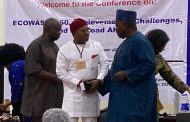
All hail the ‘Garkuwan Mista-Ali Gurum’ (left) with a friend (right)
Intervention would not be surprised if this were to turn out to be the case. On December 30th, 2025, Prof Kwaja was conferred with the title of Garkuwan Mista-Ali Gurum by His Royal Highness, Chief Dr. Danladi Akinga Kasuwa, the Ogomo of Mista-Ali in Pengana Chiefdom of Bassa LGA of Plateau State. Some of Kwaja’s friends such as Dr. Sunday Musa Onalo, the Public Relations Officer of the UNIJOS Alumni Association Global, framed it as “a powerful affirmation of Professor Kwaja’s enduring commitment to scholarship, community service, peacebuilding, and nation-building” As mentioned already, he once served as Commissioner of Local Government and Chieftaincy Affairs in Plateau State. He has served as Country Director of the United States Institute of Peace (USIP) and is a Global Fellow of the Centre for Human Rights and Humanitarian Studies, Watson Institute of International Affairs, Brown University, United States. In 2018, Kwaja gained acclaim and resonance at the United Nations where he was appointed the African Representative of the United Nations Working Group on Mercenaries. What this means is that Prof Kwaja has a rich civil society as well as think tanking experience.
No one expects Prof Kwaja to be a duplicate of any other Nigerian politician but be himself in agentian praxis. However, those who have worked with him in the civil society argue that he will bring with him comparatively sound appreciation of the nature of primary contradictions in Nigeria as well as uncommon sense of urgency to leadership.
What sort of politician he becomes remains to be seen. What is comforting is that he has read or was taught or interacted with some of the best and brightest in terms of Middle Belters who held public office recently such as Dr. Jonathan Zwingina, Dr. Iyorchia Ayu, Prof Jonah Elaigwu, Chief Audu Ogbeh, Chief Solomon Lar and, of course, General T. Y Danjuma, amongst many others and their replica in contemporary Nigeria. There is a good reason to add the late Akwe Doma whose contributions to Nigeria have not received the level of recognition it deserves.

How is it that with children like these, the Middle Belt is still lost in a messy conceptual framework?
But, of these, Chief Solomon Lar was the politician’s politician. Coming into the arena with a narrative, he was such that even his critics found him admirable. His emergence as the pioneer Chairperson of the People’s Democratic Party (PDP) in 1998 speaks to that. It was a national vote of confidence on him and what he symbolised.
So, is Prof Kwaja, like the late Chief Solomon Lar, storming the arena with a narrative that will make even his critics admire him or is he continuing in the tradition of grumbling and victimhood which degrades the Middle Belt, with particular reference to a clear statement of what it wants from Nigeria rather than escorting and fighting other people’s battles for them? It is anyone’s narrative and the demand on Nigeria the narrative embodies that ought to determine who is an ally or opponent of his main constituency, not fantasmatic recall of history or finger pointing praxis in an atmosphere of electoral democracy.
These are compelling questions made even more so when a professor enters politics. For an extraordinarily challenged part of Nigeria like the Middle Belt, especially in terms of bewildering diversity, unique underdevelopment, generalised insecurity generated by infiltration of deadly renegade fighters and yet a strategic responsibility in ‘Going on with ONE Nigeria’, the search for those with training and experience in framing the issues into national consensus is not a job for everyone.
Senator David Mark always had the opportunity to accomplish this but the frame game is not his forte, being a military man. Dr. Iyorchia Ayu was the last Middle Belter with the advantage of certificate and political education (certificate without political education is nothing) to have gone far in this. Why he wasn’t that forthcoming till he lost the throne is still a puzzle. Senator George Akume, the incumbent Secretary to the Government of the Federation has not been heard venturing into conceptual politics (be it Middle Belt, Federalism, North, development strategy, foreign relations and what have you). He might still be warming up. Surely, all these are bound to be Prof Kwaja’s references in the stream called politics.
The background makes the question inescapable: what might Prof Kwaja be bringing along should this speculation turn out to be more than an idle one? Is he going to be a combination of Aminu Tambuwal (coasting Southeast and Southsouth most weekends to attend a social engagement); Jonathan Zwingina (ran a credible, multi-identity presidential campaign that raised the banner of hope so high) and then Solomon Lar, the grandmaster? Only time will tell!